

Ceremonies & Spellwork
12 Gods and Goddesses of Autumn: Harvest, Transformation & Balance
Sep
12 Gods and Goddesses of Autumn: Your Sacred Guides for Harvest, Transformation & Balance
Autumn is not an ending. It is a threshold.
As the days grow shorter, the leaves turn gold and crimson, and the Earth offers us her final abundance, we enter the sacred season of harvest, gratitude, and preparation for the dark.
Across cultures, people have long honored deities connected with harvest, agriculture, fruit, seasonal change, and the cycles of life and death. Therefore, autumn gives us a beautiful opportunity to explore these ancient connections while reflecting on our own cycles.
There isn’t one single “Goddess of Fall.” Instead, we find guardians of ripe fruit, grain, wine, seasonal change, and the descent into the underworld.
In modern Pagan traditions and the Wheel of the Year, these themes become especially meaningful around Mabon and the Autumn Equinox.
So, let’s explore 12 gods and goddesses connected with autumn and harvest themes. Along the way, you’ll also find simple ways to bring their symbolism into your seasonal practice.
Greek Gods and Goddesses of Autumn
1. Phthinoporon – The Goddess Who IS Autumn
If you’re looking for the literal Greek personification of autumn, Phthinoporon offers one of the closest matches. Connected to the seasonal cycle, she represents autumn itself: ripening, gathering, and the gentle turn toward winter.
Her medicine: She teaches us to honor endings without sadness. Moreover, she reminds us that releasing is a natural part of every cycle.
Autumn ritual: Place dried leaves on your seasonal altar. Then, take a moment to breathe and say:
“I honor what ripened and what now rests.”
2. Carpo (Karpo) – Goddess of Ripe Fruit
Carpo’s name connects directly with fruit and the abundance of the Earth. She represents the moment when we can finally gather what we planted and nurtured.
Her medicine: Abundance, gratitude, receiving, and recognizing the fruits of your own labor. In other words, Carpo reminds us that receiving is also part of the cycle.
Ritual: Place apples, grapes, or another seasonal fruit on your altar. Next, write down three things in your life that finally bore fruit this year.
3. Opora – Goddess of the Late Harvest
Opora connects with ripe fruit and the late summer harvest, when summer slowly begins turning toward autumn.
Because of this connection, she carries the symbolism of the intense sweetness that arrives when something has finally reached maturity.
Her medicine: Completion, satisfaction, and recognizing when something is finally ready.
Ritual: Use grapes, figs, grape juice, or wine as a seasonal offering. As you taste it, reflect on something in your life that has finally reached completion.
4. Demeter – The Mother of the Harvest
Demeter is the great Greek goddess of agriculture, grain, wheat, and the fertility of the Earth.
Her mythology connects deeply with the seasonal cycle through the story of her daughter Persephone and her descent into the Underworld. As a result, Demeter carries powerful themes of harvest, separation, grief, and eventual return.
Her medicine: Sacred grief, nourishment, and connection to the cycles of the Earth. Above all, her story reminds us that periods of rest eventually give way to renewal.
Symbols: Wheat, barley, sickles, poppies, bread, and the cornucopia.
Ritual: Bake bread or prepare something made from grains. Afterward, place a small portion on your altar as an offering of gratitude for the abundance you have received.
5. Persephone – Queen of the Underworld and Return
Persephone is the daughter of Demeter and Queen of the Underworld.
In modern Pagan interpretations, her descent often symbolizes autumn. We move away from the brightness of summer and enter a season of introspection, mystery, and inner transformation.
Her medicine: Transformation, shadow work, intuition, descent, and rebirth. Therefore, her symbolism can feel especially powerful when you’re moving through a personal transition.
Sacred symbol: The pomegranate.
Ritual: Sit quietly with a pomegranate on your altar. Then ask yourself:
“What part of me needs to descend in order to be reborn?”
6. Dionysus (Bacchus) – God of Wine and Transformation
Dionysus often appears as the god of wine and celebration. However, his symbolism goes much deeper.
The grape begins as fruit and later becomes wine. Through that transformation, something temporary becomes something we can preserve, share, and celebrate.
His medicine: Celebration after effort, transformation, pleasure, community, and turning the ordinary into something sacred.
Ritual: Raise a glass of wine, grape juice, cider, or another seasonal drink. Finally, make a toast to everything you have survived, created, and harvested this year.
Roman Deities of Harvest, Orchards & Change
7. Pomona – Goddess of Orchards
Pomona is the Roman goddess connected with fruit trees, orchards, and cultivated gardens.
Rather than representing untamed wilderness, Pomona symbolizes nature that receives consistent care and attention. Therefore, she beautifully represents the things we consciously cultivate in our lives.
Her medicine: Cultivated self-love, patience, healthy boundaries, and caring for what you want to grow.
Ritual: Care for or prune a plant in your home. While you remove dead leaves or branches, imagine yourself releasing something that no longer supports your growth.
8. Vertumnus – God of Change and the Seasons
Vertumnus is a Roman deity connected with seasons, gardens, fruit trees, and transformation.
His mythology includes his ability to change form. Consequently, he offers a powerful seasonal symbol of adaptability and transformation.
His medicine: Flexibility and learning to move with change rather than resisting it.
Ritual: Stand in front of a mirror and remember the person you were at the beginning of the year. Now acknowledge the person standing in front of you today.
Consider what changed and what you learned along the way.
Finally, ask yourself: What version of myself am I becoming?
9. Ceres – Roman Goddess of Grain and Agriculture
Ceres is the Roman goddess of agriculture, grain, nourishment, and cultivated abundance. Additionally, she shares many similarities with the Greek goddess Demeter.
Her medicine: Sustenance, security, nourishment, and gratitude for the resources that support life.
Ritual: Create a small gratitude altar with grains, bread, seasonal fruit, and a candle in a warm autumn color. Then, spend a few minutes acknowledging what currently supports and nourishes you.
Celtic Deities and the Harvest Season
10. Lugh – God of Light and Mastery
Lugh is a major figure in Irish mythology connected with skill, mastery, and many arts.
His name also connects with Lughnasadh, the traditional festival that marks the beginning of the harvest season.
His medicine: Skill, courage, mastery, and recognizing what you have learned through experience.
Ritual: Light a candle and write down your skills, talents, and accomplishments from this year.
Most importantly, don’t minimize them. Your abilities are part of your harvest too.
11. Tailtiu – The Woman Behind the Harvest Festival
In Irish mythology, Tailtiu was the foster mother of Lugh. According to tradition, she cleared land so people could turn it into fertile farmland, and she died from the effort.
Lugh later established funeral games in her honor. Over time, these traditions became connected with Lughnasadh.
Her medicine: Honoring the labor behind abundance. Furthermore, her story reminds us to remember the people whose work made our own lives possible.
Ritual: Place a photograph, heirloom, or symbolic object representing your ancestors on your altar. Then, thank those who came before you for the work, sacrifices, and wisdom that helped create the path you now walk.
12. Mabon ap Modron – A Modern Autumn Association
Mabon ap Modron is a figure from Welsh mythology. However, there is an important distinction worth knowing.
Historically, Mabon was not the god of the Autumn Equinox.
The use of the name “Mabon” for the modern Pagan Autumn Equinox celebration developed much later. Today, however, many modern Wiccan and Pagan traditions connect Mabon with themes of balance, gratitude, harvest, and the transition between light and darkness.
His seasonal symbolism: Balance, transition, mystery, and the continuing cycle between darkness and light.
Ritual: Place one black candle and one white candle on your altar. Next, light both and say:
“I honor the light.
I honor the darkness.
And I honor the wisdom found between them.”
How to Work With Autumn Deities on Your Altar
You don’t need to work with all twelve. Instead, choose one or two whose symbolism connects with what you’re experiencing right now.
- For release and shadow work: Persephone + Vertumnus
- For abundance and gratitude: Carpo, Pomona, Dionysus, Ceres, or Demeter
- For balance and closing cycles: Phthinoporon, Opora, or Mabon
- For honoring your effort: Tailtiu, Lugh, or Demeter
What to Put on an Autumn Altar
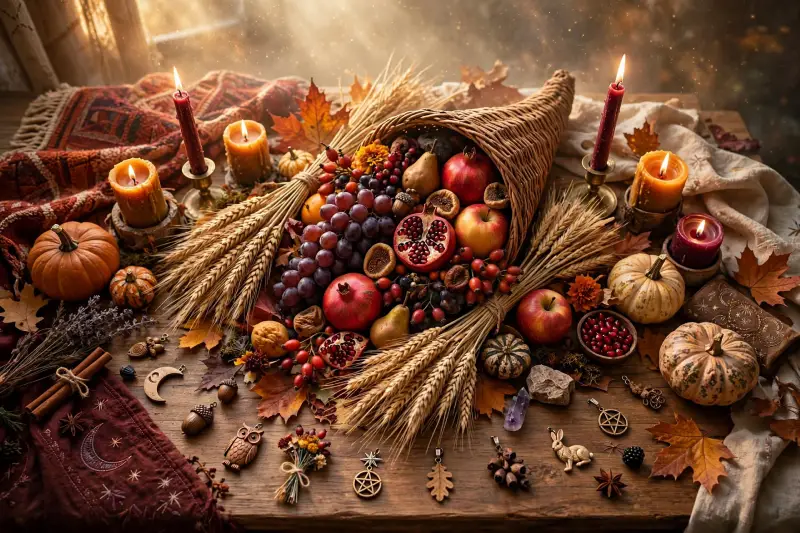
Your autumn altar doesn’t need to be complicated or expensive. Instead, begin with what the season naturally gives you.
- Apples
- Pomegranates
- Grapes
- Wheat stalks
- Dried leaves
- Mini pumpkins
- Bread or grains
- Wine or apple cider
- Acorns
- Seasonal herbs
- Candles in burgundy, burnt orange, brown, gold, or deep green
Additionally, you can add objects that represent something you personally harvested this year. For example, add a photograph, journal entry, finished project, business milestone, or another symbol of growth.
A Simple Autumn Reflection Ritual
First, sit quietly in front of your altar and take a few slow breaths.
Next, look at the symbols of harvest around you. Allow yourself to notice what each one represents before asking:
What have I harvested?
What am I ready to release?
What am I quietly preparing for the season ahead?
Afterward, write your answers in your journal without trying to make them perfect.
Autumn reminds us that not everything needs to bloom forever. Some things ripen, while others reach the moment when we can finally gather them. Eventually, other things must fall away so something new can grow.
Your Autumn Practice
Ultimately, autumn doesn’t ask you to rush into the next version of yourself. Instead, it invites you to notice what has already changed.
Consider what you’ve harvested this year and what you’re ready to release. Then, think about what you want to carry with you into the darker half of the year.
Tell me in the comments: Which of these autumn deities called to you the strongest?
If you’re building your seasonal practice, explore our ritual tools, altar kits, and handcrafted spiritual supplies created to help you bring intention into your everyday magic.
With harvest love and magic,
MJ
Oma’s Sacred Tools